P.C. Saxena Auditorium, IIT Bombay
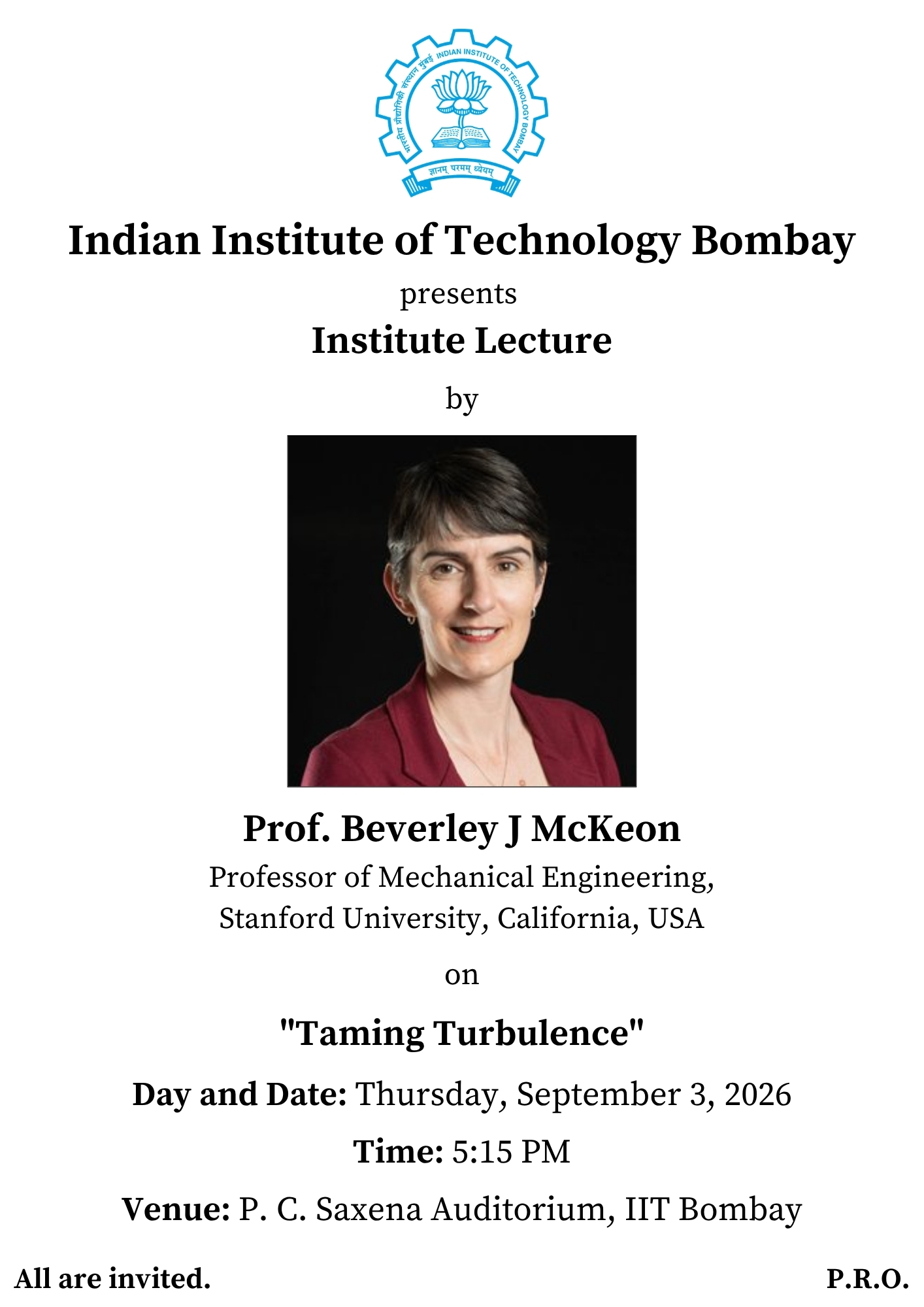
The Indian Institute of Technology Bombay is organizing an Institute Lecture on Thursday, September 3, 2026.
The details of the lecture are provided below:
- Title: Taming Turbulence
- Speaker: Prof. Beverley J. McKeon, Professor of Mechanical Engineering, Stanford University, California, USA
- Day and Date: Thursday, September 3, 2026.
- Time: 5:15 p.m.
- Venue: P.C. Saxena Auditorium, IIT Bombay
About the Speaker:
Beverley J. McKeon is a Professor of Mechanical Engineering at Stanford. She received her B.A., M.A. and M.Eng. from the University of Cambridge in the United Kingdom and an M.A. and Ph.D. in Mechanical and Aerospace Engineering from Princeton University. She completed postdoctoral research and a Royal Society Dorothy Hodgkin Fellowship at Imperial College London. Best known for her work pioneering resolvent analysis as an equation-driven tool to analyze and predict the dynamics of turbulent flow, her research group has specialized in addressing its application to understand and modify wall turbulence in numerical data and via experiments with external forcing. Prof. McKeon is a Fellow of the APS and the AIAA and the recipient of a Vannevar Bush Faculty Fellowship from the DoD in 2017, the Presidential Early Career Award (PECASE) in 2009 and an NSF CAREER Award in 2008, as well as Caltech’s Shair Program Diversity Award, Graduate Student Council Excellence in Mentoring Award and Northrop Grumman Prize for Excellence in Teaching. She currently serves as co-Lead Editor of Physical Review Fluids and on the editorial board of the Annual Review of Fluid Mechanics.
Speaker's webpage: https://mckeon.stanford.edu
Abstract:
Turbulence remains one of the outstanding problems of classical physics and one that has challenged physicists and engineers alike for decades, even centuries. The fusion of classical approaches and tools of the modern day – theoretical analysis of the Navier-Stokes equations, state-of-the-art experimental observations, data-driven methods and machine learning – has led to substantial progress towards understanding the mechanisms sustaining turbulence, developing predictive capabilities, and achieving the potentially revolutionary goal of harnessing or taming turbulence in large-scale (high Reynolds number) practical settings. In this talk, I will describe some fundamental challenges posed by turbulence near walls, the impact of this phenomenon on many of the world’s pressing scientific concerns and some recent advances.